High Yield Savings Account vs CD: Choosing Your 2026 Strategy
Deciding between a high yield savings account vs CD in 2026? Learn how interest rates, liquidity, and economic trends impact your cash strategy this year.

Deciding where to park your cash has become increasingly complex as we move through 2026. For many American savers, the primary dilemma remains the choice between a high yield savings account vs CD. Both options offer a significant upgrade over traditional brick-and-mortar savings accounts, but they serve very different purposes in a well-rounded financial plan. While a high-yield savings account offers the flexibility to move money at will, a Certificate of Deposit (CD) typically rewards you for locking your money away for a predetermined period.
Understanding the mechanics of interest rates this year is crucial. As the Federal Reserve continues to manage economic stability, the gap between liquid savings and fixed-term instruments has shifted. Whether you are building an emergency fund or saving for a down payment, picking the right vehicle for your cash requires a deep look at your timeline, risk tolerance, and the current rate environment. In this guide, we break down the most common questions surrounding these two heavyweights of the banking world to help you maximize your 2026 earnings.
What is a high-yield savings account and how does it function in 2026?
A high-yield savings account (HYSA) is a type of deposit account that typically pays a much higher interest rate than standard savings accounts. Most HYSAs are offered by online banks that don't have the overhead costs of physical branches, allowing them to pass those savings on to consumers in the form of higher Annual Percentage Yields (APYs).
In 2026, the primary characteristic of an HYSA remains its variable rate. This means the bank can change the interest rate at any time, usually in response to shifts in the federal funds rate. If you are wondering are high yield savings accounts FDIC insured?, the answer is generally yes, provided the institution is a member of the FDIC. This provides protection for up to $250,000 per depositor, per ownership category. For savers who value liquidity above all else, the HYSA is the gold standard, offering the ability to withdraw funds whenever an unexpected expense arises without facing the penalties typically associated with time-deposit accounts.
How does a Certificate of Deposit (CD) differ from a savings account?
A Certificate of Deposit is a time-deposit account. When you open a CD, you agree to leave your money with the bank for a specific term—ranging from a few months to several years. In exchange for this commitment, the bank usually provides a fixed interest rate that is guaranteed for the duration of the term.
This "rate lock" is the defining feature of a CD. While an HYSA rate might drop next month if the economy cools, a CD rate is set in stone the moment you fund the account. However, this comes with a trade-off: liquidity. If you need your money back before the term ends, you will likely face an early withdrawal penalty, which can eat into your principal. Savers often find themselves comparing CD vs Treasury Bill to see which fixed-income asset provides better protection against falling interest rates during the current year.
High yield savings account vs CD: Which offers better rates right now?
As of May 2026, the rate environment has reached a point of stabilization. Historically, CDs offered a "premium" over savings accounts to compensate for the lack of liquidity. However, in the current market, the difference is often marginal. Some top-tier HYSAs are yielding within 0.25% of 12-month CDs.
According to the FDIC's National Rates and Rate Caps, the national average for standard savings is still remarkably low, making both HYSAs and CDs attractive alternatives. While a 1-year CD might offer a 4.75% APY, a high-yield savings account might sit at 4.40%. The decision often comes down to whether you believe rates will rise or fall. If you believe the Federal Reserve will cut rates later this year, locking in a CD rate now is a savvy move. If you think rates might climb higher, staying liquid in an HYSA allows you to jump into higher-paying accounts as they become available.
| Account Type | Typical APY (2026) | Liquidity | Best For |
|---|---|---|---|
| High-Yield Savings | 4.25% - 4.60% | High | Emergency Funds |
| 6-Month CD | 4.50% - 4.85% | Low | Short-term Goals |
| 12-Month CD | 4.60% - 5.10% | Low | Planned Purchases |
| 5-Year CD | 4.00% - 4.50% | Very Low | Long-term Safety |
| Standard Savings | 0.45% | High | Convenience |
When is the flexibility of a high-yield savings account the better choice?
Liquidity is the most compelling reason to choose a high-yield savings account over a CD. Financial experts generally recommend having three to six months of expenses in an accessible account. Because life is unpredictable, having these funds in a high-yield savings account ensures that you can handle a car repair or medical bill without having to pay a penalty to access your own money.
Furthermore, for those who are still learning how much money should I keep in savings?, the HYSA serves as an excellent "bucket" for multi-purpose savings. Many online banks allow you to create "sub-accounts" or "vaults" within a single HYSA to track different goals like a vacation fund, a tax reserve, or a wedding budget. This level of granularity is much harder to achieve with CDs, which usually require a separate account opening process for every term and amount.
Under what conditions should you choose a CD over a savings account?
A CD is the superior choice when you have a specific, known expense on the horizon—such as a home down payment in 12 months—and you want to ensure that your interest rate does not drop before you need the money. It effectively removes "reinvestment risk," which is the risk that when you get your money back, the available interest rates will be lower.
In 2026, many investors use CDs as a defensive part of their portfolio. While liquid accounts are great for emergencies, CDs offer a psychological barrier to spending. If you know that withdrawing money will cost you three months of interest, you are less likely to dip into that fund for a non-essential purchase. For those with larger balances, investigating best jumbo CD rates 100k+ can yield even higher returns than standard retail CDs, making them a powerful tool for preserving wealth.
How does the Federal Reserve impact my choice between these two?
The Federal Reserve's monetary policy is the primary engine behind the rates offered on both HYSAs and CDs. According to the Federal Reserve Board's recent statements, their primary goal is to maintain price stability. When the Fed raises the federal funds rate, banks generally increase the rates they pay on savings products to remain competitive.
However, there is a delay. HYSAs react almost instantly to Fed moves because their rates are variable. CDs, conversely, are forward-looking. If the market expects the Fed to cut rates in six months, you might find that a 2-year CD actually pays a lower rate than a 6-month CD—a phenomenon known as an inverted yield curve. Savers in 2026 must look at the Federal Reserve's H.15 report to see where market yields are heading before deciding whether to lock in a long-term CD or stay flexible with a savings account.
Are there tax implications I should consider for either account?
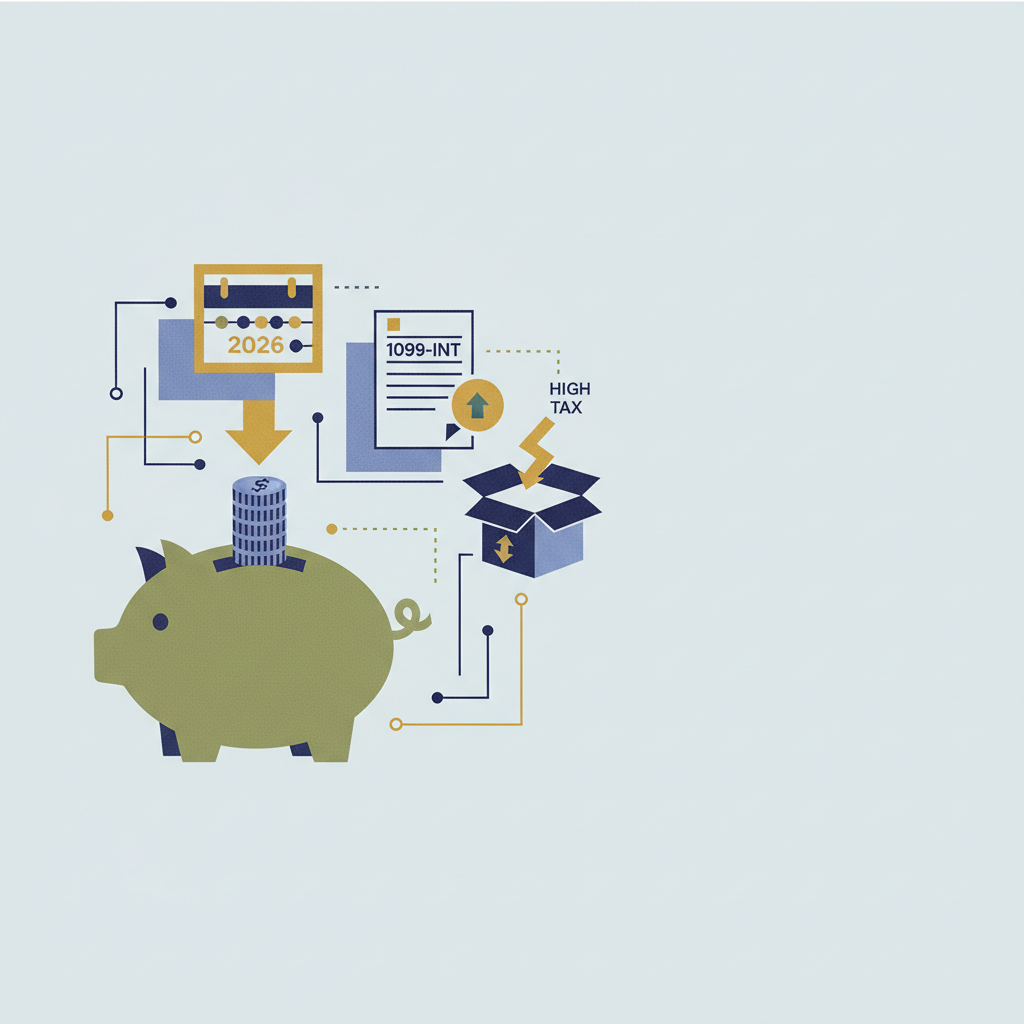
Regardless of whether you choose a high yield savings account vs CD, the interest you earn is considered taxable income by the IRS. Your bank will send you a Form 1099-INT at the beginning of the year if you earned at least $10 in interest. This interest is taxed at your ordinary income tax rate, which can be as high as 37% depending on your bracket.
One nuance with CDs is that you owe taxes on the interest in the year it is credited to your account, even if the CD hasn't matured yet. For example, if you have a 5-year CD that pays interest annually, you must report that interest every year, even though you cannot touch the money without a penalty. Savers looking for more detail should consult a high yield savings account taxes 2026 guide to understand how to minimize the impact on their net returns.
Can I use both a high-yield savings account and a CD simultaneously?
Most financial planners suggest a hybrid approach. This involves keeping your emergency fund in a high-yield savings account for immediate access while putting supplementary cash into a "CD Ladder." A CD ladder involves opening multiple CDs with different maturity dates (e.g., a 3-month, 6-month, 9-month, and 12-month CD).
As each CD matures, you have the option to either spend the cash or reinvest it into a new 12-month CD. This strategy provides a blend of the high rates associated with longer-term CDs and the periodic liquidity associated with savings accounts. It is one of the most effective ways to hedge against interest rate volatility in 2026, ensuring that some of your money is always becoming available every few months.
What are the risks associated with these accounts in 2026?
While both HYSAs and CDs are considered "low-risk" because of FDIC and NCUA insurance, they are not "no-risk." The biggest threat to a cash saver is inflation. If your high-yield savings account is paying 4.5% but inflation is running at 5%, your "real" rate of return is negative -0.5%. Your purchasing power is actually shrinking even though your balance is growing.
Another risk specific to CDs is the opportunity cost. If you lock into a 3% CD for five years and rates suddenly spike to 6%, you are stuck with the lower rate unless you pay a penalty to break the CD. This is why many people in 2026 prefer shorter-term CDs or HYSAs, as they allow for more frequent adjustments to the current economic reality. Before committing, check a CD early withdrawal penalty calculator to see just how much it would cost you to exit a fixed-term agreement early.
How do I choose the best bank for these accounts?
The "best" bank often depends on your technological preferences and your existing banking footprint. Top-tier online banks like Ally, Marcus by Goldman Sachs, and SoFi often lead the market in HYSA rates. However, many credit unions offer highly competitive CD rates to their members as a way to attract deposits.
When evaluating a bank in 2026, look beyond the APY. Check for monthly maintenance fees, minimum balance requirements, and the quality of their mobile app. Some banks require a $10,000 minimum to get the best CD rate, while others allow you to start with as little as $500. For those living in specific regions, looking at local options like best local banks in Phoenix can sometimes reveal "promotional" CD rates that beat the national online averages.
What are the alternatives to HYSAs and CDs for cash?
If neither a high yield savings account vs CD feels right, you might consider a Money Market Account (MMA). MMAs are a hybrid of savings and checking accounts; they usually offer high yields similar to HYSAs but come with limited check-writing abilities and a debit card. This can be useful for making large sporadic payments, like property taxes or quarterly estimated tax payments.
Another alternative gaining traction in 2026 is the Treasury Bill. T-Bills are backed by the full faith and credit of the U.S. government and, unlike bank interest, are exempt from state and local taxes. For savers in high-tax states like California or New York, a T-Bill yielding 5.0% might actually put more money in your pocket than a CD yielding 5.2% after taxes are settled.
Frequently asked questions
- Yes. Because emergency funds require immediate accessibility, an HYSA is generally better. CDs charge penalties for early access, which defeats the purpose of an emergency reserve.
Related articles
See all →