How Savings Account Interest Is Calculated: A 2026 Math Guide
Master the formulas behind your bank balance. Learn exactly how savings account interest is calculated in 2026 to maximize your APY and compound earnings.

Sarah, a freelance graphic designer in Chicago, sat at her kitchen table in June 2026 staring at her digital bank statement. She had finally reached her goal of keeping $20,000 in her emergency fund, but the math wasn't quite adding up in her head. Her bank advertised a 4.75% Annual Percentage Yield (APY), yet the monthly deposit into her account was roughly $78. If she multiplied $20,000 by 0.0475, she expected $950—not realizing that monthly interest is just a small slice of that annual pie. Sarah’s confusion is common among consumers who understand that money grows but aren't entirely sure of the mechanics. Understanding how savings account interest is calculated is the first step toward moving from a passive saver to a strategic wealth builder.
To solve her puzzle, Sarah needed to look past the marketing headlines and into the daily operations of her financial institution. Most modern banks, especially the online-centric ones she used for her high-yield savings accounts, use a method called the daily balance method. This means the bank doesn't just look at her balance once a month; it looks at it every single day. For Sarah, whose income fluctuated and who occasionally dipped into her savings for business expenses before replenishing them, this distinction was vital. It meant every day her money sat in the vault, it was working, even if only for twenty-four hours at a time.
By the end of the week, Sarah had done her homework. She discovered that the simple multiplication she attempted was only half the story. To truly maximize her returns, she had to account for the frequency of compounding—the 'interest on interest' that makes modern banking so powerful. Whether you are managing your own emergency fund or looking into choosing the best savings account for kids, the formula remains the same. It is a blend of your principal balance, the nominal interest rate, and the calendar, all working in a synchronized dance to determine your monthly payout.
The Core Mechanics: How Savings Account Interest Is Calculated
When we discuss how savings account interest is calculated, we must first distinguish between the interest rate and the Annual Percentage Yield (APY). The interest rate is the base percentage the bank pays you, while the APY reflects the total amount of interest you earn in a year, including the effect of compounding. According to the FDIC's National Rates and Rate Caps, the national average for savings accounts often sits much lower than the top-tier online rates Sarah was chasing. Throughout 2025 and into 2026, the gap between traditional brick-and-mortar banks and online-only institutions has remained significant, making the math even more important for those looking to optimize their cash.
The most common formula used by banks today is the Daily Balance Method. To find your daily interest, the bank takes your annual interest rate (not the APY) and divides it by the number of days in the year (usually 365, though some use 360). For Sarah’s 4.75% account, the daily rate is approximately 0.0001301. Each day, the bank multiplies this tiny decimal by her closing balance. If she keeps $20,000 in the account for 30 days, the bank performs this calculation 30 times and adds the results together at the end of the statement cycle.
This granularity is why your monthly interest varies. A 31-day month like March will always pay more than a 28-day February, even if your balance stays exactly the same. It also highlights the importance of timing. If Sarah had moved $5,000 out of her account on the 15th of the month to cover a tax bill, she would earn interest on $20,000 for the first half of the month and interest on $15,000 for the second half. This is far fairer to the consumer than the older 'low balance' method, where banks would pay interest only on the lowest amount present during the entire month.
"Interest compounding frequency is the engine of long-term wealth; even small daily increments transform stagnant cash into a growing asset over time."
The Power of Compounding Frequency
Compounding is the process where the interest you’ve already earned begins to earn interest of its own. In Sarah’s case, if her bank compounds interest daily and credits it monthly, the 'new' money added to her account in June becomes part of the principal for July’s calculation. This is why high-yield savings accounts are such an effective tool for short-term goals. Over a single month, the difference might be cents. Over a decade, it can be thousands of dollars.
Most high-yield accounts in 2026 use daily compounding. This means the interest is calculated every day and added to your 'accrued interest' bucket. At the end of the month, that bucket is dumped into your main balance. From that moment on, that interest is now part of the principal. If Sarah were to compare this to other products, such as an annuity, she would see different growth patterns. While learning about the pros and cons of annuities for your 2026 retirement, it becomes clear that while savings accounts offer high liquidity and daily compounding, other vehicles might offer different tax advantages or fixed payouts.
However, for someone like Sarah, liquidity was the priority. She needed to know that if her car broke down, she could withdraw funds without the heavy hit of a CD early withdrawal penalty. Because savings account interest is calculated on a daily basis, she never 'loses' progress by withdrawing money; she simply stops earning interest on the specific dollars she took out starting the very next day. This flexibility is the hallmark of the modern savings account.
APY vs. Interest Rate: The Marketing Math
Banks love to highlight the APY because it is always slightly higher than the interest rate. This isn't just marketing fluff; it's a standardized way to help consumers compare apples to apples. The Truth in Savings Act, overseen by the Consumer Financial Protection Bureau, requires banks to disclose the APY so you know exactly what $100 will earn over 365 days, regardless of how often the bank compounds.
If Sarah’s interest rate was 4.65% and it compounded daily, her APY would be roughly 4.75%. That 0.10% difference represents the 'interest on interest' earned throughout the year. When you are looking at how much should I keep in savings, these small percentage points matter—especially if you are holding six months of expenses. For a $50,000 emergency fund, the difference between a 1% APY and a 5% APY is $2,000 a year in 'free' money just for choosing the right institution.
Impact of External Rates on Your Calculation
It is important to remember that the number used in your calculation—the interest rate—is rarely fixed in a savings account. Unlike a Certificate of Deposit (CD), where you lock in a rate for a set term, a savings account has a variable rate. This rate is influenced by the Federal Open Market Committee (FOMC) and the federal funds rate. As we have seen in early 2026, when the Federal Reserve adjusts benchmarks, banks often follow suit within days.
Sarah noticed that her bank emailed her in April saying her rate was 'adjusting to market conditions.' This meant that the 'r' in her interest formula changed overnight. If the Fed cuts rates to stimulate the economy, Sarah’s daily interest calculation will result in a smaller number. This is the trade-off for the liquidity she enjoys. If she wanted to freeze her interest calculation at a specific number, she might have looked at a CD or a jumbo CD for large deposits, but that would mean giving up the ability to pull money out whenever she needed it for her business.
Taxation and Your Net Interest
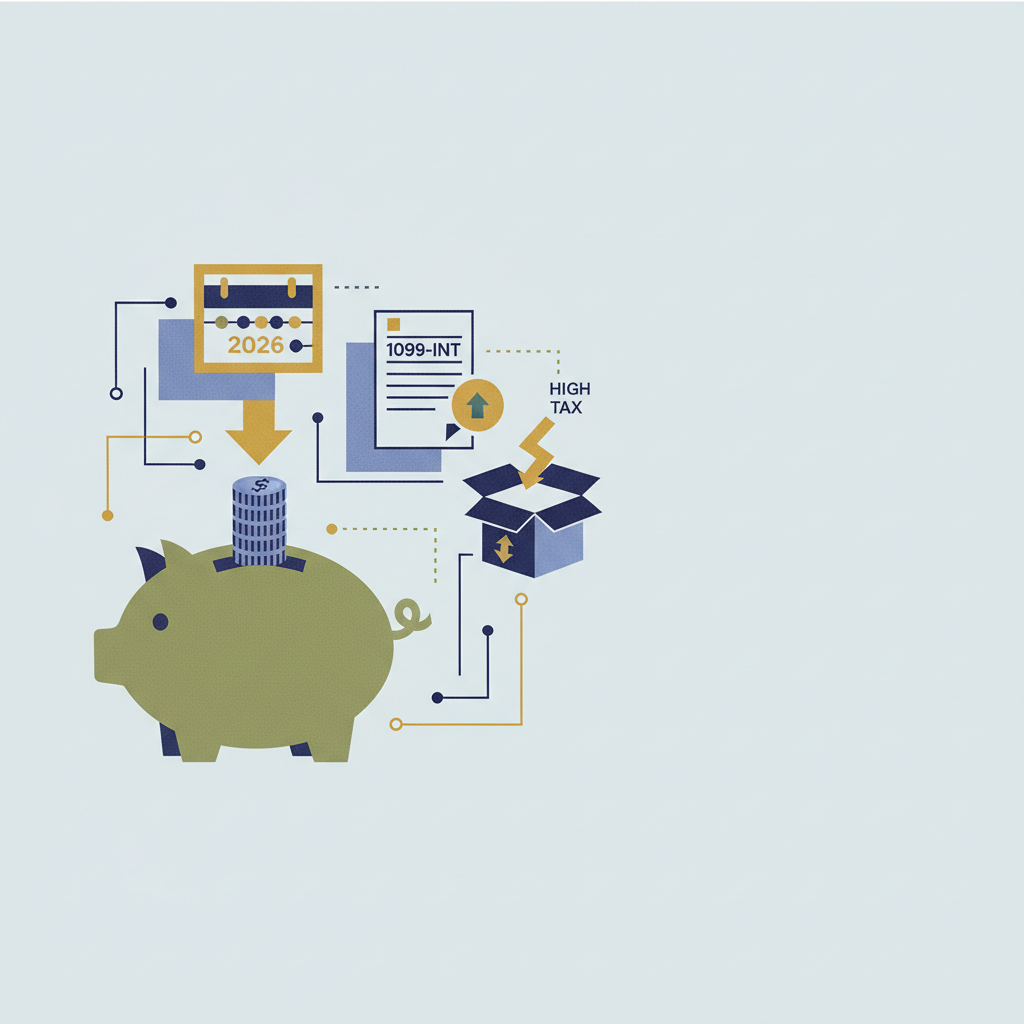
One thing Sarah forgot to calculate was the 'Uncle Sam' factor. The interest you earn in a savings account is considered taxable income. At the end of the year, usually by January 2027 for her 2026 earnings, her bank will send a Form 1099-INT if she earned more than $10 in interest. This means that if her account earned $1,000, and she is in the 22% tax bracket, she will eventually owe $220 of that interest back to the IRS.
When sophisticated savers ask how savings account interest is calculated, they are often actually interested in the 'real' rate of return—the interest minus inflation and taxes. In 2026, with inflation hovering around 2.5%, a 4.75% APY provides a 'real' gain of about 2.25% before taxes. For Sarah, this was enough to keep her purchasing power growing while maintaining the safety of FDIC insurance limits. Understanding these layers of the calculation allowed her to set more realistic expectations for her financial growth.
Practical Steps Sarah Took to Maximize Interest
Once Sarah mastered the math, she changed her banking habits in three specific ways. First, she moved her 'slush fund'—money sitting in her non-interest-bearing checking account for 15 days before bills were due—into her high-yield savings account. Since interest is calculated daily, even those 15 days of 'float' earned her a few extra dollars each month.
Second, she automated her deposits to happen the same day she received client payments. By getting the money into the account 48 hours earlier than usual, she added two extra days of principal to her daily balance calculation. Third, she stayed vigilant about her bank's rate. She knew that if her bank stopped being competitive, her daily interest would suffer compared to the market leaders. She didn't need to jump every time a bank offered 0.05% more, but she knew the threshold at which a move was worth the effort.
In the grand scheme of Sarah's life, an extra $10 or $20 a month might seem small. But for her, it was about the principle of efficiency. She worked hard for her money; she wanted to ensure the bank was working just as hard to reward her for keeping it there. By understanding the daily balance method and the effect of compounding, she turned her bank statement from a confusing list of numbers into a predictable, manageable part of her business plan.
Frequently asked questions
- Banks typically use the daily balance method by dividing your annual interest rate by 365 days to get a daily periodic rate. This rate is then multiplied by your end-of-day balance. The sum of these daily amounts is credited to your account at the end of the month.
Final Thoughts on the Savings Formula
By following Sarah’s journey, it becomes clear that 'set it and forget it' isn't always the best strategy for your cash. The math of banking is transparent if you know where to look. Whether you are using a standard account or investigating a no-penalty CD vs traditional CD, the goal is to align the calculation method with your personal needs for liquidity and growth.
For Sarah, the kitchen table session ended with a sense of clarity. She adjusted her spreadsheet, moved $3,000 from her zero-interest checking into her savings, and set a calendar reminder to check the national rate averages every quarter. She realized that while she couldn't control the Federal Reserve, she could control exactly how long every dollar sat in its most productive environment. In the world of 2026 finance, where every basis point counts, knowing the 'how' behind your earnings is the ultimate competitive advantage.
Related articles
See all →