Strategy Guide: How to Build a 5 Year CD Ladder in 2026
Learn how to build a 5 year CD ladder in 2026 to maximize interest income while maintaining liquidity. Follow our step-by-step guide to mastering your personal finances.
Stability and yield are the twin pillars of any sophisticated cash management strategy, and as we navigate the financial landscape of July 2026, savers are increasingly looking for ways to capture high rates without locking away their entire nest egg for half a decade. If you are wondering how to build a 5 year CD ladder, you are looking for the sweet spot between the safety of a savings account and the higher returns of long-term time deposits. A CD ladder allows you to benefit from the premium rates usually reserved for long-term certificates of deposit while ensuring that a portion of your money becomes available for use every single year.
The current economic environment in 2026 presents a unique opportunity. While short-term rates have stabilized relative to the volatility of 2025, the yield curve still rewards those who are willing to commit funds to longer durations. By structuring your portfolio through a ladder, you avoid the "all-in" risk of committing all your capital to a single rate that might be surpassed in twelve months. Instead, you create a rolling portfolio that captures the best of both worlds. This guide walks you through the transition from a casual saver to a disciplined laddering investor, providing the criteria, options, and final decision-tree you need to succeed in the current year.
Understanding the Situation: Why a 5 Year CD Ladder Matters in 2026
Most savers default to either a high-yield savings account (HYSA) or a single CD. While a HYSA offers maximum liquidity, its rate can drop the moment the Federal Reserve adjusts its policy. If you've been watching what happens to HYSA rates when Fed cuts rates, you know that variable-rate accounts can be a blessing in a rising rate environment but a burden when rates fall.
On the other hand, putting all your money into a single 5-year CD captures a higher rate but leaves you vulnerable to early withdrawal penalties if an emergency arises. A 5-year CD ladder solves this by splitting your total investment into five equal parts, each with a different maturity date. This means 20% of your total principal matures every year. In a world where the FDIC's National Rates and Rate Caps fluctuate, this rolling maturity acts as a hedge against interest rate risk.
The Mechanics of the Ladder
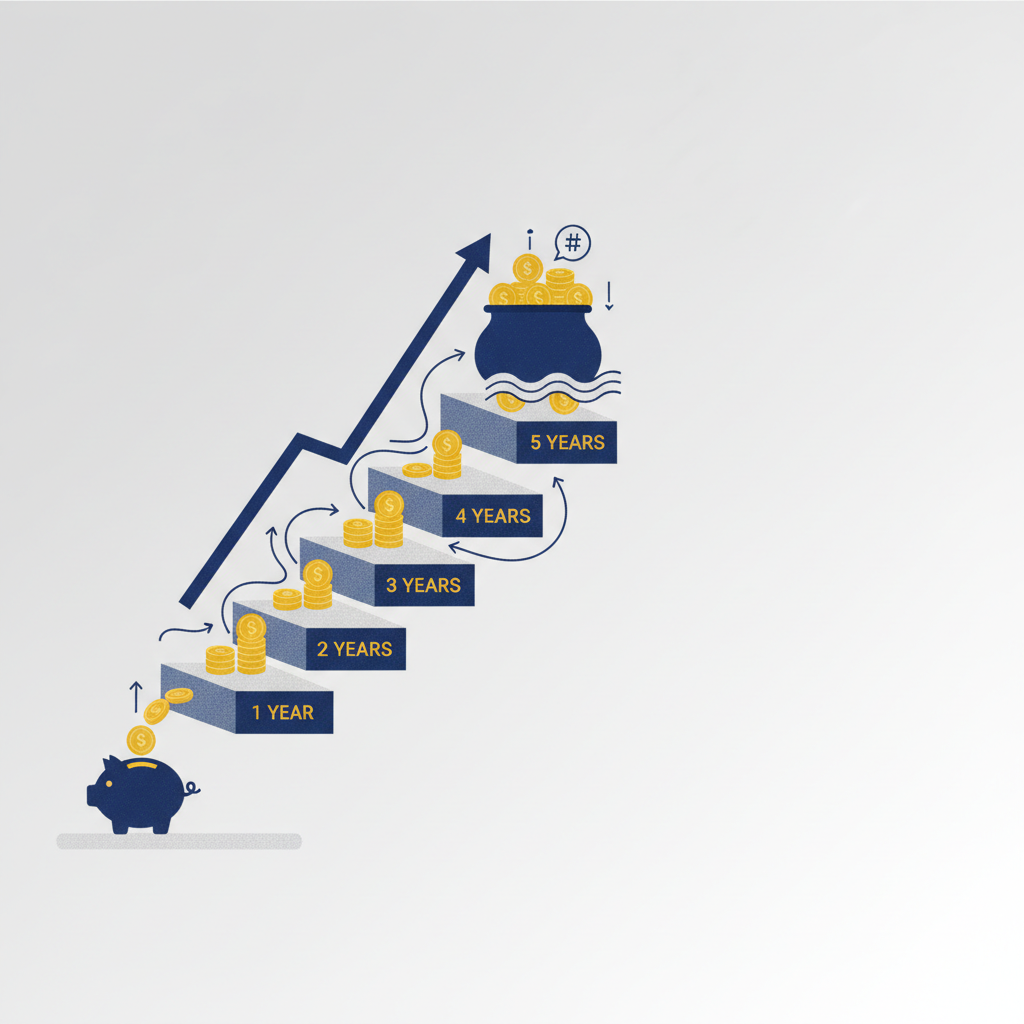
To understand how to build a 5 year CD ladder, you must first visualize the structure. Imagine you have $25,000 to invest. Instead of putting it all into one account, you would open five separate CDs of $5,000 each: 1. A 1-Year CD 2. A 2-Year CD 3. A 3-Year CD 4. A 4-Year CD 5. A 5-Year CD
When the first 1-year CD matures in 2027, you won't just put that money back into another 1-year term. Instead, you reinvest that $5,000 plus the interest earned into a new 5-year CD. By the time 2031 rolls around, every single one of your CDs will be a high-yielding 5-year instrument, but they will still be maturing one year apart. This is the ultimate goal of laddering: getting 5-year yields with 1-year liquidity.
Criteria for Choosing Your CD Providers
Not all banks are created equal when it comes to time deposits. Before you start funding your ladder, you need to evaluate institutions based on four primary criteria: APY, early withdrawal penalties, minimum deposit requirements, and insurance coverage.
- Annual Percentage Yield (APY): In 2026, online-only banks continue to lead the market, often offering rates that are 10 to 20 times higher than traditional brick-and-mortar branches. According to recent Federal Reserve H.15 data, the spread between top-tier online rates and the national average remains significant.
- Early Withdrawal Penalties (EWP): Life is unpredictable. If you need to break a CD, the penalty can eat into your principal. Some banks charge 90 days of interest for a 1-year term, while others might charge up to a full year's interest for a 5-year term. Always check the fine print for "no-penalty" options, though these often come with lower APYs.
- Minimum Deposits: If you are learning how to invest 10000 dollars in 2026, you might find that some high-yield options require $2,500 or $5,000 per term. For smaller ladders, look for banks with $0 or $500 minimums.
- Safety: Ensure every bank you use is a member of the FDIC (or NCUA for credit unions). This guarantees your deposits up to $250,000 per depositor, per insured bank, for each account ownership category.
Comparison of Options for Your 2026 Ladder
Choosing where to park your cash requires comparing different styles of institutions. While some investors prefer the simplicity of keeping all rungs of their ladder at one bank, others "rate shop" to get the absolute best yield for each specific term length.
| Institution Type | Typical 1-5yr APY Range | Best For | Liquidity Rating |
|---|---|---|---|
| Online High-Yield Banks | 4.25% - 5.05% | Maximizing Yield | Moderate |
| Credit Unions | 4.15% - 4.90% | Local Service | High |
| Brokerage CDs | 4.30% - 5.15% | Convenience | High (Secondary Market) |
| Big National Banks | 0.05% - 2.50% | Convenience | Low (Poor Yield) |
| No-Penalty CDs | 3.50% - 4.10% | Uncertainty | Maximum |
When comparing these, you might also consider alternative cash shelters. For instance, comparing high yield savings vs treasury bills can help you decide if a portion of your ladder should actually be in government-backed securities, which are exempt from state and local taxes.
Step-by-Step Guide: How to Build a 5 Year CD Ladder
Now that you understand the theory and the market, let's walk through the tactical execution.
Step 1: Determine Your Total Principal
Only use money that you are reasonably sure you won't need for the next 12 months. Since the first rung of your ladder won't mature for a year, your emergency fund should remain in a liquid savings account or an interest-bearing checking account. If you are a student or just starting out, you might even look into the best checking accounts for college students to keep your daily spending money separate from your investment ladder.
Step 2: Divide Into Five Equal "Rungs"
Take your total amount and divide by five. If you have $50,000, each rung is $10,000. If you have a large sum, be mindful of the jumbo CD minimum deposit explained in recent industry guides, as larger deposits can sometimes unlock even higher promotional rates.
Step 3: Open the Accounts Simultaneously
On Day 1, you will open five separate CDs. - Rung 1: 12-month CD - Rung 2: 24-month CD - Rung 3: 36-month CD - Rung 4: 48-month CD - Rung 5: 60-month CD
Step 4: The Reinvestment Cycle
In twelve months, your 1-year CD will mature. This is a critical moment. You have the choice to take the cash or reinvest. To maintain the ladder, you take the principal and the interest from that matured 1-year CD and open a new 5-year CD. In the second year, your original 2-year CD matures, and you move that into a new 5-year CD as well.
Step 5: Automate and Monitor
Many banks allow you to set "maturity instructions." You can often tell the bank to automatically move the funds to a savings account upon maturity so you can manually shop for the best new 5-year rate, or you can set it to auto-renew (though auto-renewal often defaults to a lower standard rate).
The 5-Year CD Ladder Strategy
- Provides a predictable income stream with annual liquidity
- Mitigates interest rate risk through diversification of maturity dates
- Typically earns higher average APYs than a standard savings account
- FDIC-insured safety for absolute principal protection
- Money is less liquid than a savings account or money market fund
- Early withdrawal penalties can be steep if you break a rung
- Requires active management once a year to reinvest matured funds
- Inflation might outpace CD yields during periods of high price growth
Advanced Strategy: The Brokerage Ladder
For those who want a more hands-off approach, building a ladder through a brokerage account (like Fidelity, Schwab, or Vanguard) offers some unique advantages. Brokerage CDs, also known as "brokered CDs," often have higher yields because banks compete globally for your deposit. Additionally, if you need your money back early, you can often sell the CD on the secondary market.
However, be cautious about callable CD risks explained. If you buy a callable CD, the bank has the right to "call" it back and return your principal before the 5-year term is up if interest rates fall significantly. This could break your ladder and force you to reinvest at a lower rate earlier than planned.
The Decision: Is a CD Ladder Right for You?
Before you commit, you must assess your personal time horizon. A CD ladder is not a replacement for a long-term retirement strategy involving equities or annuities. If you are looking for guaranteed lifetime income, you might find that a SPIA vs deferred annuity comparison is more relevant to your goals. However, for the "cash" portion of your portfolio—money meant for a house down payment in five years or a supplement to Social Security—the 5-year ladder is hard to beat.
Tax Implications of Your CD Ladder
One often-overlooked aspect of knowing how to build a 5 year CD ladder is the tax bill. The IRS treats CD interest as taxable income in the year it is earned, even if you don't withdraw it from the account. If your ladder starts generating significant returns, you need to be prepared for the 1099-INT forms you’ll receive each January. For a deeper dive, check out our guide on how CD interest is taxed in 2026 to learn about tax-deferred options like IRA CDs.
Furthermore, the Consumer Financial Protection Bureau (CFPB) reminds consumers to review their account disclosures carefully. In 2026, some institutions have introduced "dynamic" penalties that change based on market rates at the time of withdrawal. Understanding these nuances before you lock in the first rung of your ladder can save you thousands in potential fees.
Final Recommendations for 2026
As you begin building your ladder, remember that the "5-year" part is just a template. You can build 3-year ladders, 10-year ladders, or even "barbell" ladders where you only invest in very short and very long terms. The key is consistency.
By starting today, you are essentially buying insurance against falling rates while maintaining the flexibility to jump on higher rates if they appear in the future. In the current economic climate, that kind of flexibility is the ultimate financial asset.
Frequently asked questions
- You can start with as little as $500 per rung at many online banks. If you have $2,500 total, you can open five $500 CDs. Some credit unions even offer "starter" CDs with $50 minimums.
Related articles
See all →