High Yield Savings vs Money Market Account: Which Is Best in 2026?
Discover the differences in the high yield savings vs money market account debate to find the best home for your cash and maximize your interest earnings in 2026.

Sarah, a freelance graphic designer living in Seattle, found herself in a common financial predicament in early 2026. She had managed to accumulate a $35,000 emergency fund, which sat in a traditional brick-and-mortar savings account earning a negligible 0.01% APY. After reading about the Federal Reserve's recent shifts in monetary policy, she realized her idle cash was effectively losing purchasing power against inflation. Sarah knew she needed a better vehicle for her capital, but she was stuck at a crossroads: should she choose a high yield savings vs money market account to house her hard-earned reserves?
Initially, Sarah was attracted to the simplicity of the high-yield savings account (HYSA). She had heard friends rave about online banks offering rates that were significantly higher than the national average. However, as someone who frequently needed to move money for quarterly tax payments, she was also intrigued by the transactional flexibility promised by money market accounts (MMAs). Her dilemma highlights a fundamental question for many American savers: does the convenience of a debit card and check-writing capability outweigh the potentially higher yields of a streamlined savings product?
As we move through 2026, the distinction between these two vehicles has blurred, yet critical differences remain regarding how you access your money and the fees you might incur. Understanding the trade-offs in the high yield savings vs money market account debate is essential for anyone looking to optimize their high-yield savings accounts while maintaining the liquidity required for life’s unexpected expenses.
The Fundamental Mechanics of Modern Yield
To understand Sarah's choice, we must first look at what defines these accounts in the current economic environment. A high-yield savings account is a type of deposit account typically offered by online-only banks or the digital arms of large financial institutions. Because these banks don't have the overhead of physical branches, they pass the savings onto the consumer in the form of higher interest rates. According to the FDIC's National Rates and Rate Caps, the national average for savings accounts often hovers well below 1%, whereas high-yield options in 2026 frequently exceed 4.5% or 5.0% APY.
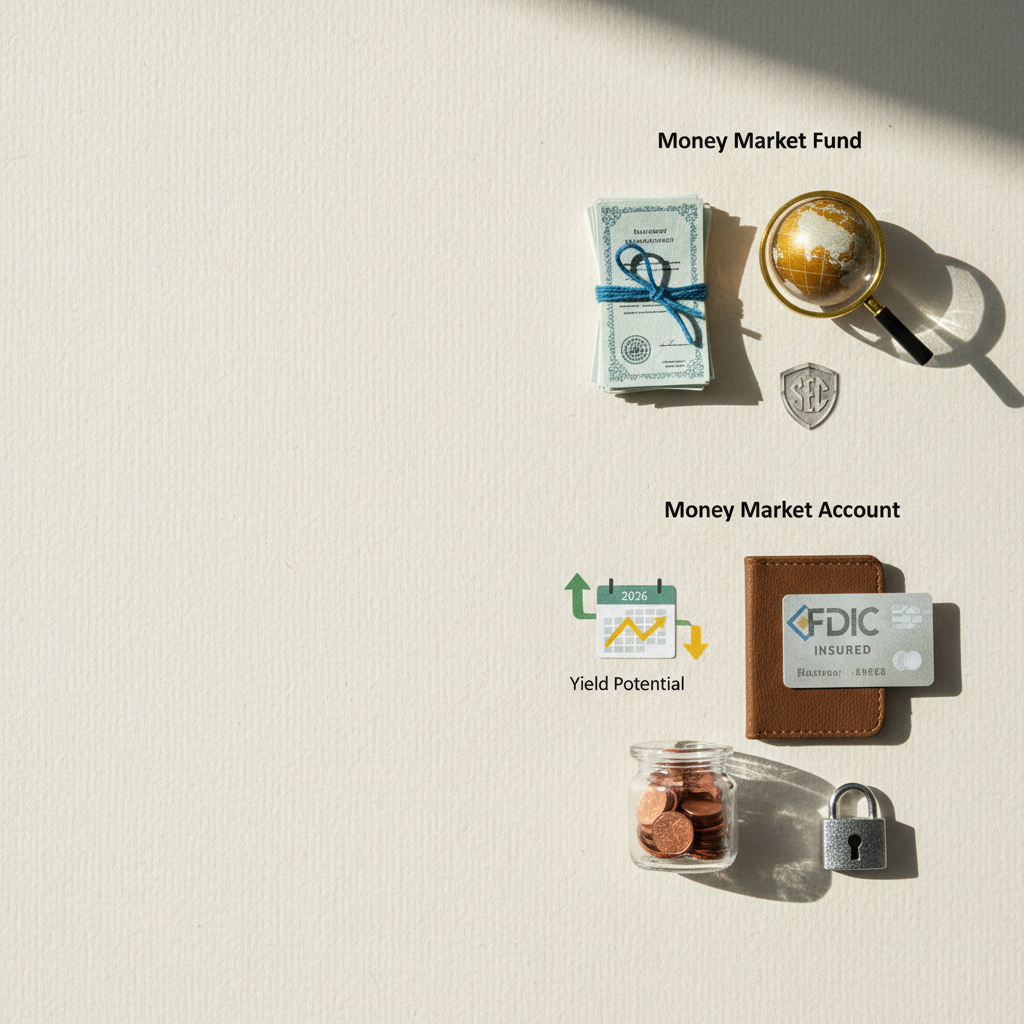
On the other hand, a money market account is a hybrid product. It combines the interest-earning potential of a savings account with some of the functional features of a checking account. MMAs often come with a debit card or the ability to write a limited number of checks per month directly against the balance. While this sounds like a clear win for the MMA, Sarah discovered that these features often come with strings attached, such as higher minimum balance requirements to waive monthly maintenance fees.
Accessibility and the Transactional Gap
For Sarah, the primary concern was accessibility. She didn't want her money 'locked away,' even though both accounts are considered liquid. In the high yield savings vs money market account comparison, the MMA usually wins on the front of immediate access. If Sarah chose a money market account, she could potentially pay her tax bill by writing a check straight from her emergency fund. With a standard HYSA, she would typically need to transfer the funds to an external checking account first, a process that can take one to three business days depending on the bank’s ACH transfer speeds.
However, it is important to note that the Federal Reserve's Regulation D, which previously limited 'convenient' withdrawals from savings and money market accounts to six per month, remains a point of confusion for many. While the Federal Reserve Board made changes in 2020 to allow banks more flexibility, many institutions still enforce a six-transfer limit to manage their own reserve requirements. Sarah had to carefully check the fine print of each bank she considered to ensure she wouldn't be hit with 'excessive transaction fees' if she had a particularly busy month of transfers.
Comparing Yield Stability and Performance
In early 2026, interest rates have shown signs of stabilizing after several years of volatility. When Sarah compared the top-tier best high-yield savings accounts 2026, she found that online-only HYSA providers were slightly more aggressive in their rate offerings than those offering MMAs. This is often because money market accounts require the bank to maintain more infrastructure (like debit card processing and check clearing), which adds to the operating cost and can slightly depress the APY offered to the customer.
If your goal is purely the highest possible return on a dormant pile of cash, the HYSA is often the winner. Sarah realized that for her $35,000 balance, a difference of 0.25% in APY would result in an extra $87.50 per year. While not a life-changing amount, over five or ten years of compounding, the gap becomes more pronounced. She began to wonder if the 'convenience' of an MMA was worth the 'convenience tax' of a slightly lower interest rate.
""Modern liquidity isn't just about how fast you can spend; it's about how efficiently your cash works for you while it's waiting to be spent.""
The Role of Minimum Balances and Fees
One of the pitfalls Sarah encountered during her research was the discrepancy in fee structures. Many of the most competitive high-yield savings accounts have shifted toward a 'no-minimum, no-fee' model to attract younger, more mobile customers. This is particularly true for those featured in our looks at best free checking accounts no minimum 2026, where digital transparency is the standard.
Money market accounts, conversely, often lean into a more traditional banking model. Sarah found several MMAs that offered high rates only if she maintained a balance of $10,000 or more. If her balance dipped below that threshold, the interest rate would plummet to a 'base rate'—sometimes as low as 0.05%—and she would be charged a $15 monthly service fee. This 'yield trap' is a critical factor in the high yield savings vs money market account evaluation. For Sarah, whose freelance income fluctuated, a high minimum balance requirement felt like an unnecessary risk.
Safety and Insurance in 2026
Regardless of which account Sarah ultimately chose, safety was a non-negotiable priority. She needed to ensure her $35,000 was protected against bank failure. Both high-yield savings accounts and money market accounts at reputable banks are covered by the Federal Deposit Insurance Corporation (FDIC). This means that Sarah's deposits are insured up to $250,000 per depositor, per insured bank, for each account ownership category.
For those who prefer credit unions, the National Credit Union Administration (NCUA) provides the same level of protection. Sarah felt a sense of relief knowing that as long as she chose a covered institution, her principal was safe. This is a significant advantage over other vehicles like what is an annuity, which may have different risk profiles and liquidity constraints. When people ask is a high yield savings account safe?, the answer in 2026 remains a resounding yes, provided you stay within the federal insurance limits.
Integration with Your Financial Ecosystem
As Sarah narrowed her choices, she began to look at how a new account would fit into her overall financial strategy. She already used a robo-advisor for her long-term retirement goals, but her short-term cash needed to be more accessible. She realized that some of the best high-yield savings accounts now offer 'bucket' features, allowing her to mentally earmark money for taxes, a future vacation, and her emergency fund all within one account.
Money market accounts don't always offer these digital organization tools, focusing instead on the hardware of banking—the cards and the checks. Sarah decided that since she did most of her spending via a primary checking account, she didn't actually need another debit card in her wallet. The 'separation' between her savings and her spending was actually a psychological benefit. By keeping her emergency fund in a dedicated HYSA without a debit card, she was less tempted to dip into it for non-emergency purchases.
The Verdict for Sarah's Scenario
After two weeks of careful analysis, Sarah opted for a high-yield savings account through an online-only bank. The reasons were three-fold. First, the APY was consistently 0.15% higher than the best money market account she could find that didn't have restrictive fees. Second, she appreciated the lack of a minimum balance requirement, which suited her variable freelance income. Third, the three-day transfer window to her checking account acted as a 'cooling off' period that prevented impulsive spending of her tax reserves.
Her journey illustrates that the 'best' account isn't determined by a universal winner but by the specific behavior of the saver. If Sarah had been an older investor who preferred the autonomy of writing checks directly from a high-interest account to pay for home repairs, the money market account would have been the superior tool. For her, the high yield savings vs money market account debate ended with a focus on maximizing yield over transactional speed.
Maximizing Your Strategy in 2026
If you find yourself in Sarah's shoes, the landscape of 2026 offers more choices than ever. While this piece focused on the choice between two liquid accounts, it is also worth considering whether all your cash needs to be liquid. For example, if Sarah knew she wouldn't need $10,000 of her emergency fund for at least a year, she might have looked at finding the best 12 month CD rates 2026 to lock in a higher rate than even an HYSA could offer.
Furthermore, for those with sophisticated cash management needs, looking into the money market account hybrid strategy guide can provide insights into how to use both account types in tandem. You might use an MMA for your 'active' savings—money you plan to spend in the next 3-6 months—while keeping your 'core' emergency fund in a higher-yielding HYSA. This tiered approach to liquidity ensures that no dollar is left underperforming.
In the broader context of 2026, savers should also be aware of the 'service' aspect of their banks. While rates are important, the quality of a bank’s mobile app and the responsiveness of their customer service can have a daily impact on your financial well-being. According to data from the Consumer Financial Protection Bureau (CFPB), the number of complaints regarding digital banking access has risen as more consumers ditch local branches. Choosing a high-yield partner that offers robust security and reliable uptime is just as important as the decimal point on your APY.
Navigating the 2026 Interest Rate Cycle
We are currently in a period where the 'yield gap' between different types of accounts is widening. As the Federal Reserve manages the delicate balance of growth and inflation, banks are adjusting their rates with increasing frequency. This makes the 'set it and forget it' mentality dangerous for your wealth. Sarah’s decision to move her money from a 0.01% account to one earning 5.00% is the difference between earning $3.50 a year in interest and earning $1,750 a year on her $35,000 balance.
This dramatic difference underlines why understanding the high yield savings vs money market account distinction is so vital. It’s not just about banking terminology; it’s about the tangible growth of your safety net. Whether you prioritize the check-writing flexibility of an MMA or the streamlined, high-yield focus of an HYSA, the most important step is moving your capital to an institution that values your deposits. As Sarah learned, the cost of inertia is the only guaranteed loss in the world of personal finance.
Frequently asked questions
- Typically, a high-yield savings account is better for a static emergency fund because it usually offers a higher APY. However, if you want the ability to access funds instantly via a debit card without waiting for a bank transfer, a money market account is preferred.
By following Sarah's example and auditing your own accounts against the current 2026 benchmarks, you can ensure that your financial foundation is as strong as possible. Don't let your money sit in a legacy account out of habit. Compare the features, assess your need for direct access, and place your funds where they will serve your future self most effectively.
Related articles
See all →