SEP IRA vs Solo 401k: Which Is Best for Your Business in 2026?
Discover the key differences in the SEP IRA vs solo 401k debate for 2026. Learn about contribution limits, catch-up rules, and which plan yields the highest tax-advantaged savings.
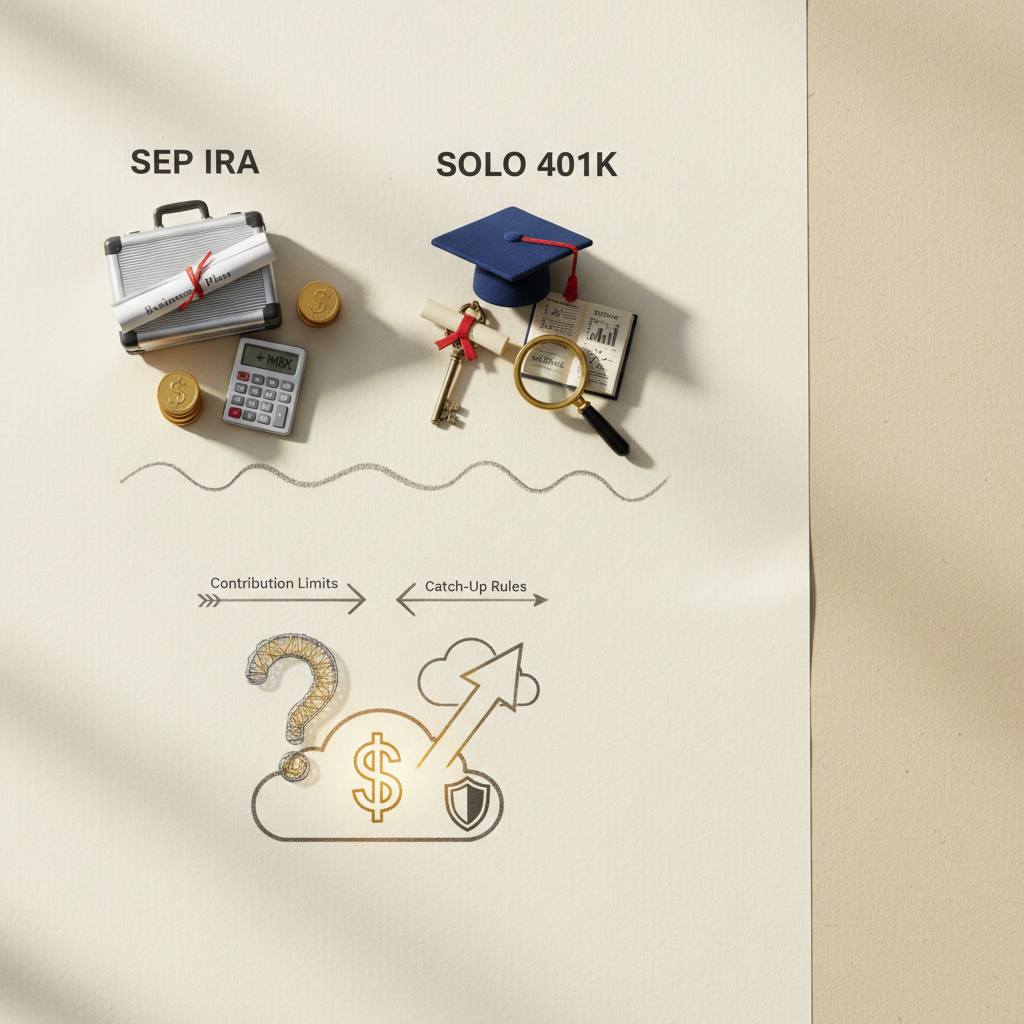
[[STATS title="By the Numbers"] $69,000 | 2026 SEP IRA Base Limit $70,000 | 2026 Solo 401k Base Limit $7,500 | Catch-up contribution (Age 50+) 100% | Potential Solo 401k salary deferral [[/STATS]]
For self-employed professionals in 2026, the choice of a retirement vehicle can mean the difference between leaving money on the table or maximizing your future wealth. Choosing between a SEP IRA vs solo 401k is no longer just a matter of convenience; it is a strategic tax move. With the IRS recently adjusting contribution thresholds to account for inflation, the ceiling for these plans has reached record highs. For a high-earner with no employees, the ability to tuck away up to $70,000 or more in a single year makes these accounts significantly more powerful than a traditional IRA or a standard workplace plan.
Understanding the nuance of the sep ira vs solo 401k comparison requires looking at how you earn your income. While both offer tax-deferred growth and potentially tax-deductible contributions, the mechanics of how you reach the maximum limit differ vastly. A Simplified Employee Pension (SEP) IRA is often praised for its simplicity, but a Solo 401(k)—also known as a one-participant 401(k)—allows for employee deferrals that can front-load your savings even at lower income levels. Whether you are a freelance consultant, a side-hustler, or a small business owner, these investing vehicles are the cornerstones of self-employed wealth building.
Comparison Breakdown: SEP IRA vs Solo 401k
To see how these two heavyweights stack up in 2026, we have gathered the most recent data on contribution limits, administrative requirements, and flexibility. Note that the Solo 401(k) often provides a higher 'effective' contribution rate for those earning under $200,000 because it treats the owner as both employer and employee.
| Feature | SEP IRA | Solo 401(k) |
|---|---|---|
| Max Contribution (2026) | $69,000 | $70,000 (plus catch-up) |
| Catch-up (Age 50+) | No | $7,500 |
| Roth Option | Yes (Recent Change) | Yes |
| Policy Loans | No | Yes (Up to $50k) |
| Setup Deadline | Tax Filing Date | Tax Filing Date |
| Admin Complexity | Very Low | Moderate (Form 5500-EZ) |
What the Numbers Actually Say
When we analyze the mechanics of the sep ira vs solo 401k, the primary differentiator is the contribution formula. According to the IRS COLA increases for 2026, the base limit for defined contribution plans has climbed. For a SEP IRA, you are generally limited to 25% of your net self-employment income (or 20% of your net adjusted profit). This means if you earn $100,000 in net profit, you can only contribute roughly $20,000.
Conversely, with a Solo 401(k), you can contribute as much as $23,500 (the 2026 employee deferral limit) plus 25% of your business profit as the employer. Using the same $100,000 profit example, a Solo 401(k) allows you to contribute the $23,500 plus $20,000, totaling $43,500. This is more than double the amount allowed in the SEP IRA for the same income level. This disparity is why many investing experts recommend the Solo 401(k) for those looking to maximize their tax-advantaged space early in their careers.
However, the SEP IRA remains a formidable tool for those with fluctuating income who want minimal paperwork. Because it does not require an annual filing until the plan assets exceed $250,000 (unlike the Solo 401k which requires Form 5500-EZ at that threshold), it is the go-to for the 'keep it simple' crowd. If you are just starting and wondering how much should I invest each month in 2026?, the SEP IRA's lack of administrative overhead might be more appealing than the higher limits of the Solo 401(k).
Structural Differences and Eligibility
The eligibility for these plans is strict but straightforward. Both require you to have 'earned income' from self-employment. This excludes passive income like rent or interest. If you are also exploring taxable brokerage vs Roth IRA: finding the best investment in 2026, you should consider how a self-employed plan fits into your wider portfolio. The SEP IRA allows you to have employees, but you must contribute the same percentage of their salary to their accounts as you do for yourself. This makes the SEP IRA expensive if you plan to grow team size quickly.
The Solo 401(k) is restricted to business owners with no employees other than a spouse. The 'solo' in the name is literal. This plan is designed specifically for the 'solopreneur.' If you eventually hire a full-time employee (usually defined as working more than 1,000 hours per year), you will be forced to transition your Solo 401(k) into a traditional 401(k), which comes with significant compliance costs and testing requirements.
Tax Treatment: Traditional vs. Roth in 2026
As of 2026, the tax landscape has become more flexible for both plans. Traditionally, SEP IRAs were only pre-tax. However, recent legislative shifts now allow for Roth SEP IRA contributions. This means you can pay taxes on the money now and enjoy tax-free withdrawals in retirement. This change makes the sep ira vs solo 401k debate more about functionality than tax status, as both now offer Roth 'buckets.'
If you prefer the tax deduction today to lower your 2026 tax bill, the traditional version of either plan works well. For those who believe tax rates will be higher in the future, the Roth Solo 401(k) or Roth SEP IRA is highly advantageous. When deciding, it may be helpful to review index funds vs ETFs explained: choosing your strategy for 2026 to determine which assets are best suited for the tax-free growth provided by a Roth-style account.
Loan Provisions and Liquidity
A major analytical point for the Solo 401(k) is the loan provision. Solo 401(k) plans often allow you to take a loan of up to 50% of the account balance (maximum $50,000). This can be a lifesaver for business owners needing a short-term cash infusion without the permanent hit of a withdrawal penalty.
SEP IRAs do not allow for loans. Any money taken out is considered a distribution, which is taxable and subject to a 10% penalty if you are under age 59½. For investors who are cautious about liquidity, the Solo 401(k) offers a safety net that the SEP IRA cannot match. While we generally advise against raiding retirement funds, the flexibility provided by the Department of Labor's guidelines regarding plan loans can be a strategic asset in a volatile economy.
Administrative Burdens: The 'Form 5500-EZ' Factor
One of the biggest 'cons' often cited for the Solo 401(k) is the filing of Form 5500-EZ. This document must be filed with the IRS once your Solo 401(k) plan contains $250,000 or more in assets at the end of the year. While the form is not overly complex, failing to file it can result in draconian penalties (sometimes upwards of $250 per day, capped at $150,000).
In contrast, the SEP IRA has virtually no annual reporting to the IRS for the business owner. You simply open the account at a brokerage, contribute, and report the deduction on your tax return. For those who want to focus entirely on their business and avoid any interaction with the Internal Revenue Service regarding plan administration, the SEP IRA is the clear winner.
Investment Flexibility and Options
Both plans typically offer wide-ranging investment options if opened at a major brokerage. You can invest in stocks, bonds, and mutual funds. Some specialized providers even allow for 'self-directed' versions that include real estate or private equity. However, the Solo 401(k) is often more compatible with a 'trustee-directed' model, giving the owner total control over the checkbook.
If your goal is a 'set it and forget it' approach, you might look into what is a target date retirement fund? A consumer guide for 2026. These funds can be held within either a SEP IRA or a Solo 401(k) and automatically rebalance as you approach your retirement year, reducing the need for constant monitoring.
Scenario Analysis: Which One Fits You?
Scenario A: The High-Earning Consultant
If you are earning $250,000 in net profit and have no employees, the SEP IRA vs solo 401k choice is a wash in terms of the maximum limit ($69k vs $70k). In this case, the SEP IRA’s simplicity likely wins out unless you specifically want the loan feature or the ability to make 'catch-up' contributions if you are over 50.
Scenario B: The Growing Freelancer
If you earn $60,000 in net profit, a SEP IRA limits your contribution to about $12,000. A Solo 401(k) allows you to contribute $23,500 plus about $12,000 as the employer, allowing for a total of $35,500. For the freelancer looking to aggressively build wealth on a moderate income, the Solo 401(k) is vastly superior.
Scenario C: The Entrepreneur with Seasonal Staff
If you have even one part-time employee who meets the hour requirements, the Solo 401(k) is off the table. You would be restricted to the SEP IRA, and you would be required to contribute for that employee if they meet the eligibility criteria (usually age 21+ and having worked 3 of the last 5 years).
What if the Fed Changes Rates?
While retirement plans are long-term vehicles, the economic environment of 2026 matters. If the Federal Reserve maintains a higher-for-longer interest rate stance, you might consider how the cash portion of your retirement account is performing. For those with high cash balances waiting for a market dip, checking what is APY on a savings account in 2026? can help you understand the opportunity cost of keeping funds in a low-interest settlement fund versus a high-yield option.
Final Verdict: Choosing the Right Path
The sep ira vs solo 401k decision hinges on three pillars: income level, administrative patience, and future hiring plans.
- Choose the Solo 401(k) if you are a solo operator who wants to maximize contributions at lower income levels, needs the option for a loan, or wants to utilize the $7,500 catch-up contribution available to those over age 50.
- Choose the SEP IRA if you want the simplest possible setup, have (or plan to have) employees, or have a very high income where the 25% cap already reaches the maximum $69,000 limit.
Regardless of your choice, the most important factor in 2026 is consistency. As market volatility continues to be a factor, staying disciplined with your contributions will do more for your retirement readiness than the specific plan type ever could. For those looking for more hands-off management, comparing the best robo advisors compared 2026: top picks for every investor can provide an automated way to manage these accounts once they are funded.
Frequently asked questions
- While you can technically have both, you cannot 'double dip' on the contribution limits. Your total contributions across all defined contribution plans are capped at $70,000 (for 2026). Most people find it administratively easier to choose one.
[[CHECKLIST title="Steps to Start Saving"] - Calculate your net self-employment profit for 2026. - Determine if you will hire employees within the next 12 months. - Decide if you need the $50,000 loan provision of a Solo 401(k). - Compare fees across major brokerages (Vanguard, Fidelity, Schwab). - Open the account before your tax filing deadline. [[/CHECKLIST]]
In the long run, the most successful investors are those who understand the tools at their disposal. The sep ira vs solo 401k comparison shows that the IRS provides a generous runway for the self-employed—provided you are willing to navigate the initial paperwork. Start today, and let compounding do the heavy lifting for your future.
Related articles
See all →