How Does a CD Ladder Work? A 2026 Strategy Guide
Discover how does a CD ladder work to balance high yields with cash liquidity. Learn how to build a 2026 certificate of deposit strategy that beats inflation.

Savers in 2026 face a persistent challenge: how to capture the highest possible yields without locking money away for years at a time. While the Federal Reserve has stabilized interest rates after the volatility of the mid-2020s, the battle against inflation remains personal. If you park all your cash in a long-term certificate of deposit (CD), you risk being unable to access those funds in an emergency. If you keep it all in a traditional savings account, you often sacrifice significant interest income. This is where a specific financial technique becomes invaluable. But exactly how does a cd ladder work, and is it still the right move for your 2026 financial plan?
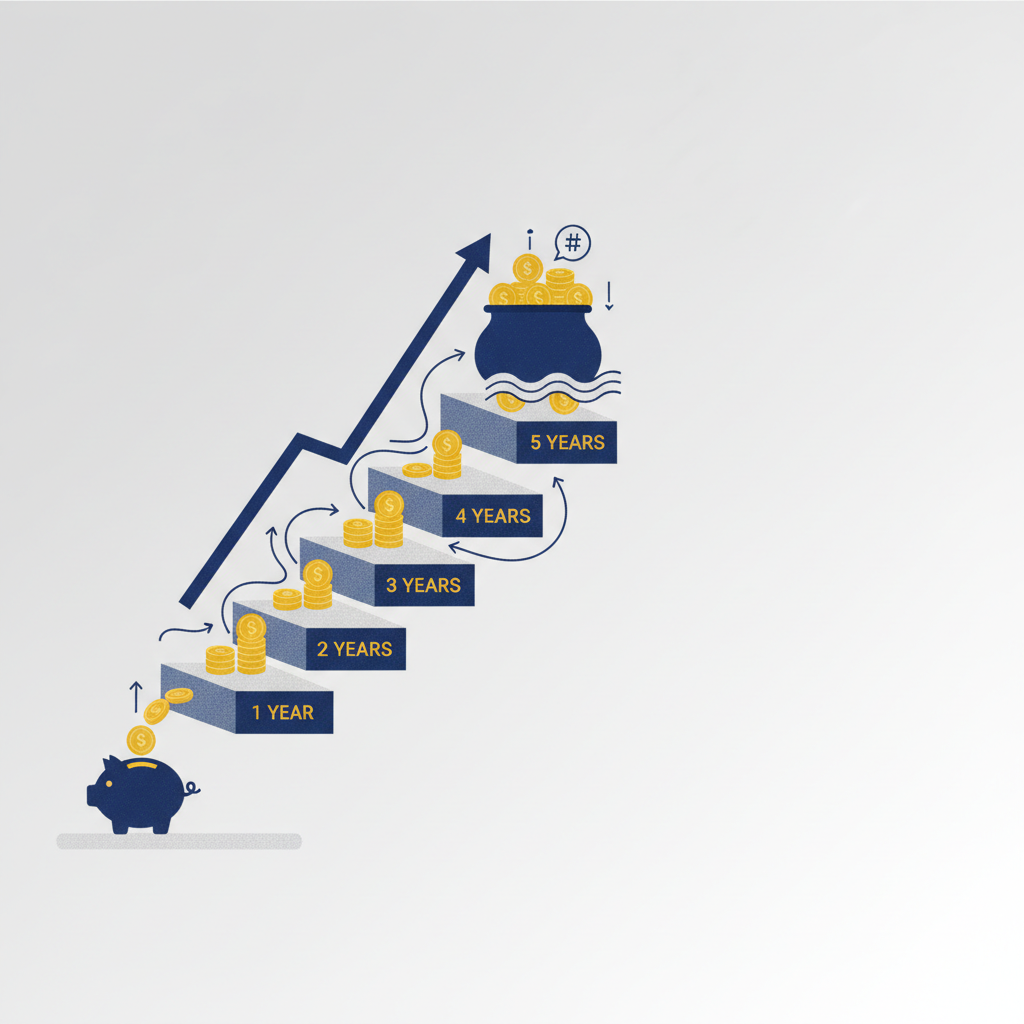
A CD ladder is a savings strategy that involves dividing a lump sum of money into equal parts and investing each part in a CD with a different maturity date. By spreading your investment across staggered terms—such as one, two, three, four, and five years—you ensure that a portion of your capital becomes available at regular intervals. This provides a constant stream of liquidity while allowing you to benefit from the typically higher interest rates offered by long-term deposits. This article will guide you through the mechanics, the benefits, and the step-by-step process of constructing your own ladder today.
Understanding the Basics: How Does a CD Ladder Work?
To understand the mechanics of this strategy, you must first look at the structure of a single certificate of deposit (CD). When you open a CD, you agree to leave your money with the bank for a fixed duration in exchange for a guaranteed interest rate. If you withdraw that money before the "maturity date," you usually face an early withdrawal penalty that can consume your earned interest and sometimes a portion of your principal.
A CD ladder eliminates the "all-or-nothing" risk of long-term CDs. Instead of putting $25,000 into one five-year CD, you might put $5,000 into five different CDs. In a standard five-year ladder, you would open: - A 1-year CD - A 2-year CD - A 3-year CD - A 4-year CD - A 5-year CD
One year later, your 1-year CD matures. You now have access to that $5,000 plus interest. If you do not need the cash, you reinvest it into a new 5-year CD. By doing this every year, you eventually reach a point where you have a 5-year CD maturing every single year. You are essentially getting the high interest rate of a 5-year term with the annual liquidity of a 1-year term.
This approach is particularly useful when comparing high yield savings vs money market accounts, which offer liquidity but often have variable rates that can drop at any moment. With a ladder, your rates are locked in for the duration of each individual "rung."
The Situation: Why You Need a Ladder in 2026
The economic environment of 2026 requires a more tactical approach to cash management. National averages for savings accounts often lag behind the top-tier rates found at online-only institutions. According to the FDIC's National Rates and Rate Caps, the spread between a standard savings account and a 5-year CD can be as much as 3% or more. Without a ladder, you are likely leaving hundreds or thousands of dollars in interest on the table annually.
You might find yourself in one of these three common situations: 1. The Risk-Averse Growth Seeker: You have a significant amount of cash but are afraid to invest in the stock market because of 2026 market volatility. You want a guaranteed return that is FDIC-insured. 2. The Near-Term Retiree: You need to ensure you have a specific amount of cash available each year for living expenses while keeping the rest of your nest egg protected from market downturns. 3. The Emergency Fund Optimizer: You have an emergency fund that is too large for a simple checking account, and you want it to work harder for you while remaining accessible.
For those just starting out, learning how to start investing with 1000 dollars often begins with cash preservation. A CD ladder provides a low-risk entry point into the world of multi-year financial planning.
The Criteria: What Makes a Good CD Ladder?
Before you begin building a cd ladder, you need to define your personal criteria for success. A ladder is not a one-size-fits-all product; it is a custom structure built on your specific needs for time and yield. Consider the following factors:
1. Frequency of Liquidity
How often do you need access to your cash? If you are using a ladder for monthly income, you might build a "mini-ladder" with CDs maturing every three or six months. If you are focused on long-term wealth, annual rungs are the standard. The shorter the rungs, the lower your overall average APY will likely be, but the more flexible your cash becomes.
2. Interest Rate Environment
Are rates rising, falling, or stable in 2026? In a rising rate environment, you want shorter rungs so you can reinvest your maturing cash into higher-yielding CDs sooner. In a falling rate environment, a CD ladder is a godsend because it allows you to "lock in" long-term high rates today before the market drops further.
3. Early Withdrawal Penalties
No matter how well you plan, life happens. Always check the penalty terms before opening a rung. Some online banks offer "no-penalty CDs" which are excellent for the first rung of a ladder, though they typically offer lower APYs. Understanding these terms is as critical as choosing the best brokerage for beginners when you eventually transition into more complex investments.
CD Ladder Options: Comparing Typical 2026 Rung Strategies
There are several ways to structure your ladder depending on your goals. Below is a comparison of common laddering configurations used by consumers in 2026 to maximize their certificate of deposit returns.
| Strategy Name | Rung Intervals | Best For | Typical Avg APY |
|---|---|---|---|
| Standard Ladder | 1, 2, 3, 4, 5 Years | Long-term growth | 4.75% - 5.25% |
| Short-Term Ladder | 3, 6, 9, 12 Months | Emergency funds | 3.80% - 4.25% |
| The Barbell | 6 Mos & 5 Years | Hedging rate changes | 4.40% - 4.60% |
| Retirement Ladder | Annual (Years 1-10) | Consistent income | 4.90% - 5.40% |
Step-by-Step: Constructing Your First Ladder
If you have decided that the standard five-year model is for you, here is how to execute the process using today's digital banking tools.
Step 1: Determine Your Total Investment
Let's assume you have $10,000. You don't want to lock it all away because you might need some of it for a car repair or a medical bill in 2027.
Step 2: Open Your Initial Rungs
Navigate to a bank that offers competitive rates. You do not have to use the same bank for every rung. In fact, searching for the best 1 year cd rates at one bank and the best 24 month cd rates at another can often net you an extra 0.20% in total yield.
You will open five separate accounts: - $2,000 in a 12-month CD - $2,000 in a 24-month CD - $2,000 in a 36-month CD - $2,000 in a 48-month CD - $2,000 in a 60-month CD
Step 3: The Annual Reinvestment
One year from today, the 12-month CD will mature. You will have $2,000 plus interest (let's say $2,100). You now take that $2,100 and open a new 60-month CD.
Why a 60-month (5-year) CD? Because your previous 60-month CD now only has 48 months left. Your 48-month CD has 36 months left, and so on. By always reinvesting the maturing short-term rung into a new long-term rung, you maintain the ladder's structure and keep your money working at the highest possible long-term rates.
The Pros and Cons of the Laddering Strategy
While this is a powerful tool, it is not without its drawbacks. As a senior banking journalist, I advise readers to weigh the friction of managing multiple accounts against the mathematical benefits of the yield.
The CD Ladder Strategy — Pros & Cons 2026
- Higher average yield than most savings accounts
- Predictable, guaranteed cash flow for budgeting
- Protects against "reinvestment risk" during falling rate cycles
- FDIC/NCUA insurance makes it virtually zero-risk for principal
- Less liquid than a high-yield savings account if an emergency exceeds one rung value
- Requires administrative upkeep (monitoring maturity dates)
- Fixed rates mean you miss out if market rates skyrocket suddenly
- Inflation may occasionally outpace the CD yield
Decision Guide: Is a CD Ladder Right for You?
Choosing between a ladder and other cash vehicles involves looking at your total financial picture. If you are already maximizing your retirement contributions, perhaps through a Roth IRA vs Traditional IRA, a CD ladder serves as an excellent "Tier 2" emergency fund.
However, if you find the 2026 rates are too low for your long-term goals, you might consider more aggressive options. Those looking for higher income in retirement often compare ladders to annuities. If you're wondering how much income will a 500k annuity pay, you'll find the yields are often higher than CDs, but the money is significantly less liquid and usually involves higher fees.
According to Federal Reserve H.15 data, interest rate trends in early 2026 suggest that locking in multi-year rates now is a prudent move for those who believe the economy may cool. By securing 5% yields today, you protect yourself against the possibility of 3% yields in 2028.
Advanced Tactics: The "Bump-Up" and "Step-Up" Rungs
In 2026, many banks have introduced flexible CD products to attract savvy consumers. If you are worried that interest rates will rise significantly after you've built your ladder, look for "Bump-Up" CDs. These allow you to request a rate increase once during the term if the bank's published rates for that product go up. This effectively mitigates the biggest "con" of the CD laddering strategy: the opportunity cost of being locked into a lower rate during a market upswing.
Another variation is the "Step-Up CD," where the interest rate is scheduled to increase at pre-determined intervals (e.g., every 6 months). While these are less common in 2026 than standard fixed-rate CDs, they can be a useful tool for the shorter rungs of your ladder.
Conclusion: Taking Action Today
Building a financial fortress in 2026 doesn't require complex derivative trading or high-risk speculation. Often, the best path forward is the one that provides clarity and consistency. The CD laddering strategy is a time-tested method that rewards discipline and patience.
Before you move your funds, ensure your current banking relationship is serving you well. If you are paying monthly maintenance fees, you are effectively negating the gains from your CD ladder. Check out our guide on the best free checking accounts 2026 to find a fee-free hub for your ladder's interest payments. Once your operational accounts are optimized, start small. You don't need $50,000 to begin; many online banks allow CD openings with as little as $500 per rung.
By understanding exactly how does a CD ladder work, you have taken the first step toward a more resilient and profitable cash management strategy. Start with one rung today, and by this time next year, you'll have the peace of mind that comes with guaranteed growth and scheduled liquidity.
Frequently asked questions
- If you need money before a rung matures, you can still withdraw it, but you will pay an early withdrawal penalty. This is why it is vital to keep a separate emergency fund in a liquid savings account or only ladder money you are 90% sure you won't need until the scheduled maturity.
Related articles
See all →