Best 5 Year CD Rates 2026: Lock in Long-Term Yields Today
Secure your financial future with the best 5 year CD rates 2026 has to offer. Learn how to lock in fixed returns and compare top-tier certificates of deposit for maximum gain.

Why are investors focusing on the best 5 year CD rates 2026?
Fixed-income investors are increasingly turning their attention toward long-duration savings vehicles as the economic landscape shifts. Securing the best 5 year CD rates 2026 provides a rare opportunity to hedge against falling interest rates while ensuring a guaranteed return on capital. In a market where high-yield savings accounts and money market accounts fluctuate based on Federal Reserve policy, a 5-year Certificate of Deposit (CD) offers a sanctuary of predictability. For many, the goal is to move beyond the volatility of the stock market and the uncertainty of variable-rate accounts to claim a piece of the high-rate environment before it potentially fades.
Finding the best 5 year CD rates 2026 requires a blend of market timing and institution research. While the FDIC's National Rates and Rate Caps often show a modest national average for standard savings, those who shop at online-only banks or credit unions often find significantly higher yields. Locking in a rate for sixty months means you are essentially making a bet that the interest rate environment will be lower in the future than it is today. If you are right, you maintain a premium yield while others are forced to accept lower returns on their liquid cash.
How do 5-year CDs compare to shorter terms in 2026?
Historically, longer-term CDs offered higher rates to compensate savers for locking up their money. However, the current yield curve has created unique dynamics. While you might see best 12 month CD rates 2026 rivaling or even exceeding long-term options, the 5-year CD serves a different purpose: duration. A 1-year CD offers a high rate today, but when it breathes its last breath in twelve months, you may be forced to reinvest that money at a much lower market rate.
The 5-year CD protects you from this "reinvestment risk." By prioritizing the best 5 year CD rates 2026, you are extending your yield horizon well into the latter half of the decade. This is particularly attractive for those planning for specific milestones, such as a child entering college or a planned retirement date. While short-term gains are tempting, as discussed in our guide to the yield lock-in strategy, long-term stability often provides superior peace of mind for the conservative portion of a portfolio.
Where can I find the highest 5-year CD yields currently?
In 2026, the battle for deposits has shifted from the big-box retail banks to nimble online institutions and community-focused credit unions. National banks often rely on their massive footprints and convenience to keep depositors, meaning they rarely offer the most competitive APYs. Conversely, online banks have lower overhead and use high rates as their primary marketing tool to attract new customers.
When searching for the best 5 year CD rates 2026, don't overlook credit unions. Because they are member-owned cooperatives, they often return profits to members in the form of higher interest rates. Before committing, ensure the institution is insured by either the FDIC (for banks) or the National Credit Union Administration (NCUA). This ensures your principal, up to $250,000 per depositor, is backed by the full faith and credit of the U.S. government.
| Institution Type | Estimated APY Range | Minimum Deposit | Penalty Type |
|---|---|---|---|
| Top Online Banks | 4.15% - 4.50% | $500 - $1,000 | 365 Days Interest |
| Leading Credit Unions | 4.20% - 4.60% | $1,000 | 180-365 Days Interest |
| National Big Banks | 1.50% - 2.75% | $2,500 | Variable |
| Specialized Jumbo CDs | 4.35% - 4.75% | $100,000 | Custom |
What are the risks of locking money into a 5-year CD?
The primary risk associated with a 5-year CD is liquidity risk. Unlike high-yield savings vs money market accounts, which allow for relative ease of access to your funds, a CD is a legal contract. You agree to leave your money with the bank for the full term. If an emergency arises and you need that cash, you will likely face an Early Withdrawal Penalty (EWP).
These penalties can be stiff, often ranging from 6 to 12 months of earned interest. In some cases, if you withdraw the money early enough in the term, the penalty could even eat into your original principal. This is why it is critical to only use money that you are certain you won't need for the next five years. For those who want more flexibility, comparing best online checking accounts 2026 might reveal better options for everyday spending and emergency reserves.
Another risk to consider is inflation. If the best 5 year CD rates 2026 are lower than the rate of inflation over that same period, your money is technically losing purchasing power. While the return is guaranteed in nominal dollars, its real-world value could decrease if the economy experiences a period of rapid price increases. According to historical Bureau of Labor Statistics CPI data, maintaining a yield that stays ahead of inflation is the key to true wealth preservation.
How does inflation impact long-term CD strategies?
Inflation is the silent killer of fixed-rate returns. When you sign up for a 5-year term, you are locking in a specific interest rate regardless of what happens to the cost of living. If the best 5 year CD rates 2026 are sitting at 4.50%, but inflation averages 5.00% over the next five years, your "real" return is actually negative 0.50%.
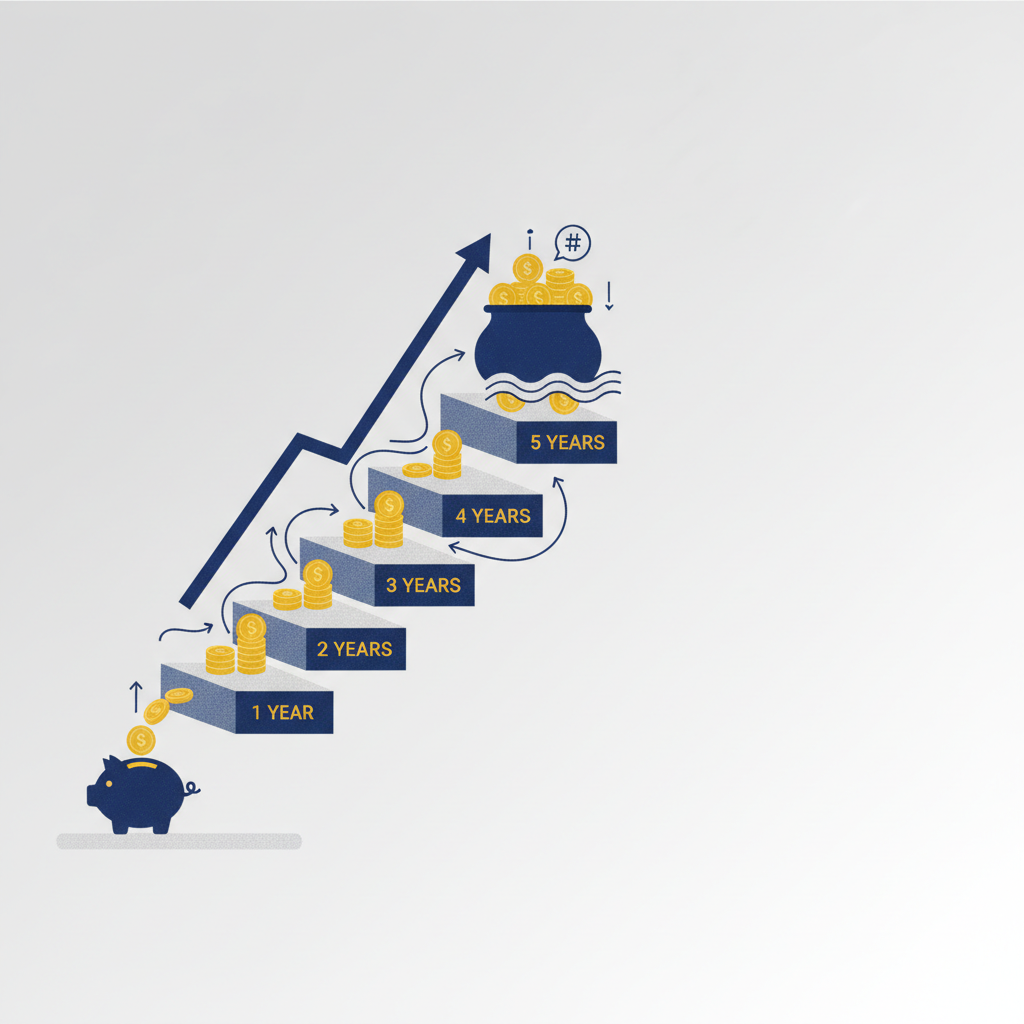
To combat this, savvy investors often use a strategy called CD laddering. Instead of putting all their cash into a single 5-year certificate, they divide the money into five equal parts and buy a 1-year, 2-year, 3-year, 4-year, and 5-year CD. Each year, one CD matures, allowing them to either spend the cash if needed or reinvest it into a new 5-year CD at current market rates. This provides a balance of high long-term yields and annual liquidity, protecting the saver from being completely stuck if inflation or interest rates rise unexpectedly.
Is a 5-year CD better than a retirement annuity?
For those looking at long-term horizons, the choice often comes down to a CD or an annuity. A 5-year CD is a straightforward banking product with FDIC insurance. It is easy to understand: you give the bank money, they give it back five years later with interest. An annuity, however, is an insurance contract.
While there are fixed vs variable annuity differences, a fixed annuity can sometimes offer higher rates than the best 5 year CD rates 2026 because they are structured differently for tax purposes. Annuities offer tax-deferred growth, meaning you don't pay taxes on the interest until you withdraw it. With a CD, you generally pay taxes on the interest earned each year, even if you don't touch the money. However, annuities often come with longer commitment periods and more complex fee structures. For most retail savers, the simplicity and federal insurance of a CD make it a more accessible choice.
What should I look for in the fine print of a CD agreement?
Not all CDs are created equal. When hunting for the best 5 year CD rates 2026, you must look beyond the headline APY. One critical detail is the frequency of compounding. Interest that compounds daily will yield more over five years than interest that compounds monthly or quarterly. Most top-tier online banks use daily compounding to maximize the effect for the consumer.
Additionally, check the grace period. When your CD matures in 2031, most banks give you a window of about 7 to 10 days to withdraw the money. If you miss this window, the bank will automatically roll your funds into a new CD for the same term at whatever the current rate is at that time. Given that the yield inertia trap is a common way banks keep low-cost deposits, you must set an alert for your maturity date so you can re-evaluate your options.
Can I lose money in a 5-year CD?
As long as the institution is FDIC or NCUA insured and you do not withdraw your funds early, it is virtually impossible to lose your principal in a CD. The only scenario where you might receive back less than you deposited is if you trigger an early withdrawal penalty that is greater than the interest you have earned to date.
This safety profile is why CDs are a cornerstone of conservative financial planning. Even if the bank fails, the Federal Reserve's regulatory framework and FDIC insurance ensure your balance is protected. For those seeking absolute safety for their nest egg in 2026, the best 5 year CD rates 2026 represent one of the most secure ways to grow wealth without the risk of market loss.
How do taxes affect my 5-year CD earnings?
Interest earned on a CD is considered taxable income by the IRS. Your bank will send you a Form 1099-INT at the end of each year detailing the interest earned. This interest is taxed at your marginal income tax rate, which can significantly reduce your effective yield. If you are in the 24% tax bracket, a 5.00% APY really feels more like 3.80% after Uncle Sam takes his cut.
To mitigate this, some investors hold CDs within a tax-advantaged account like an IRA. An IRA-CD allows the interest to grow tax-deferred (or tax-free in the case of a Roth IRA), maximizing the power of five years of compounding. When you are comparing the best 5 year CD rates 2026, consider whether the account will be held in a taxable brokerage account or a retirement shell, as this decision can change your long-term wealth outcome by thousands of dollars.
Will rates go up or down by the end of 2026?
Predicting interest rate movements is notoriously difficult, even for seasoned economists. However, historical patterns and current Federal Reserve guidance suggest that we may be at or near a peak for this cycle. If the Fed begins to prioritize economic growth over fighting inflation, they may lower the federal funds rate. When that happens, bank deposit rates—including 5-year CDs—will almost certainly follow suit.
This is why many financial advisors are suggesting that now is the time to lock in the best 5 year CD rates 2026. If you wait until the end of the year, those same 5-year terms might be offering 0.50% to 1.00% less than they are today. The goal of the smart saver is to capture the highest possible yield for the longest possible duration before the window of opportunity closes.
Frequently asked questions
- Top-tier online banks and credit unions are currently offering 5-year CD rates between 4.25% and 4.60% APY, depending on the deposit amount and institution.
Practical steps to opening your 5-year CD
- Survey the Market: Use online comparison tools to find the leading APYs for 2026. Focus on online banks that consistently rank at the top of the charts.
- Check Minimums: Ensure you have the required minimum deposit. Some of the best rates are reserved for "Jumbo" CDs requiring $100,000, but many top rates are available for as little as $500.
- Read the EWP: Understand exactly what it will cost you to break the CD early. If the bank charges 540 days of interest, you need to be very sure about your timeline.
- Open the Account: This can usually be done in under 10 minutes online. You will need your Social Security number and an external bank account to fund the new CD.
- Designate Beneficiaries: Don't forget to add a "Payable on Death" (POD) beneficiary to the account to ensure the funds bypass probate and go directly to your loved ones if something happens to you.
By following these steps and focusing on the best 5-year CD rates 2026 provides, you can build a sturdy pillar for your financial foundation. Whether you are offsetting the risks of aggressive stock market investments or simply looking for a safe place to park your hard-earned savings, the 5-year CD remains a premier choice for 2026's investors.
Related articles
See all →