Should I Open a CD or a High Yield Savings Account in 2026?
Deciding 'should I open a CD or a high yield savings' depends on your liquidity needs and the interest rate outlook for 2026. Compare rates, terms, and flexibility here.
According to most recent data from the Federal Reserve, modern American households are currently holding more than $17 trillion in various liquid assets, yet millions of savers are still missing out on hundreds of dollars in interest every year by parking cash in standard branch-based accounts. As of mid-2026, the gap between a standard savings account and a competitive yield product remains significant. Many consumers reaching out to financial experts are asking the same fundamental question: should I open a CD or a high yield savings account to protect my purchasing power? The answer isn't a simple one-size-fits-all, as it hinges on your specific timeline, your tolerance for restricted access, and where you believe interest rates are headed for the remainder of the year.
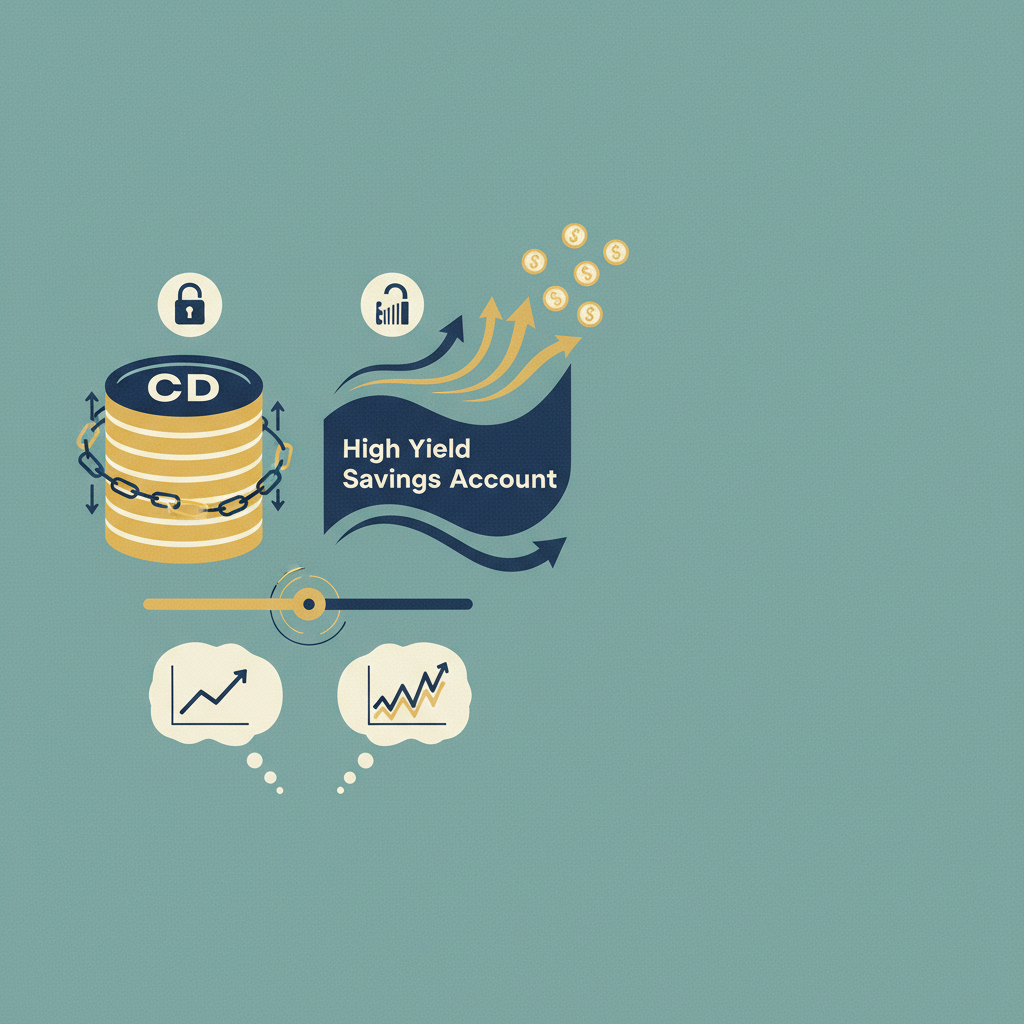
Opening the right account involves weighing the certainty of a Certificate of Deposit (CD) against the fluidity of a high-yield savings account (HYSA). While both are among the safest places to store cash, their mechanics differ in ways that can affect your long-term wealth building. By looking at current market trends and the FDIC's National Rates and Rate Caps, we can see that while national averages hover around 0.45% for standard savings, top-tier online vehicles are offering substantially more, making the choice between a CD and an HYSA more critical than ever.
What the numbers actually say: 2026 Market Comparison
To understand the financial implications of your choice, you must look at the hard data. In the current economic climate of 2026, interest rates have stabilized following a period of volatility. When you ask "should I open a CD or a high yield savings," you are essentially choosing between "locking in" a rate or "riding the wave" of market fluctuations.
| Feature | High-Yield Savings (HYSA) | 1-Year Certificate of Deposit | 5-Year Certificate of Deposit |
|---|---|---|---|
| Current Avg. APY | 4.10% - 4.60% | 4.75% - 5.15% | 4.25% - 4.50% |
| Rate Stability | Variable (Can change anytime) | Fixed (Guaranteed for term) | Fixed (Guaranteed for term) |
| Liquidity | High (Up to 6 withdrawals/mo) | Low (Early withdrawal penalty) | Low (Significant penalty) |
| Minimum Deposit | Usually $0 - $100 | Often $500 - $2,500 | Often $1,000+ |
| Best Used For | Emergency funds, taxes | Short-term goals (1-2 years) | Long-term cash preservation |
As the table illustrates, the short-term reward for committing your capital to a CD is currently higher than the flexible HYSA. However, the 5-year CD rates currently sit slightly lower than the 1-year rates—a phenomenon known as an inverted yield curve—which suggests that markets anticipate rates may flatten or decrease in the long term. This complicates the decision-making process for those looking to maximize yield: finding the best 1 year CD rates in 2026.
The Mechanics of a High-Yield Savings Account
A high-yield savings account is an evolution of the traditional savings account, typically offered by online-only banks that have lower overhead costs. Because they don't have to maintain thousands of physical branches, they pass the savings onto you in the form of higher interest. For someone wondering "should I open a CD or a high yield savings," the HYSA is the clear winner for flexibility.
These accounts are federally insured by the FDIC or NCUA, meaning your money is safe up to $250,000 per depositor, per institution. The primary advantage here is liquidity. If your car breaks down or you have an unexpected medical bill, you can move your money to a checking account almost instantly. Many consumers use these as a primary holding pen for their emergency fund. If you are just starting out, learning how to open a high yield savings account online in 2026 is one of the most effective first steps you can take toward financial stability.
However, the downside is the variable rate. If the Federal Reserve decides to lower the federal funds rate later this year, your bank will likely lower your APY within days. You have no protection against falling rates in an HYSA.
The Mechanics of a Certificate of Deposit (CD)
A CD is a time deposit. When you open a CD, you agree to leave your money with the bank for a set period—ranging from three months to five years or more. In exchange for this lack of liquidity, the bank provides a fixed interest rate. This is the biggest pull for someone asking "should I open a CD or a high yield savings" during a time when rates are expected to drop. If you lock in a 5.00% APY today and market rates fall to 3.00% next year, your CD continues to earn 5.00% until it matures.
The catch is the Early Withdrawal Penalty (EWP). If you need your money before the term ends, the bank will often charge you several months' worth of interest, which could even eat into your principal if you close the account very early. This is why investors looking at longer horizons frequently check for a lock in growth: best 5 year CD rates for July 2026 to ensure they are getting a premium for their commitment.
Analyzing Interest Rate Risk in 2026
What the numbers actually say about risk depends on the broader economy. According to the Federal Reserve's H.15 Selected Interest Rates, yields on government securities often dictate what banks are willing to pay for your deposits. In 2026, the interest rate environment has remained relatively high compared to the 2010s, but it is no longer in a steep climbing phase.
If you believe that inflation is fully under control and that the Fed will begin cutting rates to stimulate growth, the CD becomes immensely more attractive. By opening a CD now, you "pre-sell" your cash at today's high prices. Conversely, if you think inflation might resurge, staying in an HYSA is smarter because the bank will eventually have to raise your rate to stay competitive.
July 2026 Savings Statistics
When a CD is the Correct Choice
There are specific life scenarios where a CD is mathematically superior. If you have a known expense coming up—such as a down payment for a house in 18 months or a wedding next summer—the CD offers protection. Not only is the rate locked, but the "soft barrier" of the early withdrawal penalty prevents you from dipping into those funds for impulse purchases.
For those who are also managing long-term retirement vehicles, such as an annuity, a CD can act as a low-cost, low-complexity alternative for the "safe" portion of a portfolio. While some people ask are annuities a good investment for retirement? A 2026 guide, a CD offers similar fixed-rate benefits without the high fees or long-term surrender periods associated with insurance products.
When a High-Yield Savings Account is the Correct Choice
The most important use case for an HYSA is the emergency fund. Financial planners generally recommend keeping three to six months of expenses in a liquid account. If you put your emergency fund into a 2-year CD and lose your job three months later, the penalty for accessing your own money adds insult to injury.
Additionally, the HYSA is better for "sinking funds." These are pots of money for anticipated but irregularly timed expenses, like holiday shopping, annual car registrations, or home maintenance. Since you don't know exactly when the water heater will fail, you need the money to be available 24/7. Understanding what is APY on a savings account in 2026 helps you realize that even though the rate is variable, the compounding effect still works in your favor as long as the funds remain in the account.
Factors to consider for CDs in the current year
When browsing for CDs, there are three environmental factors in 2026 that you must consider:
- The Inflation Gap: Inflation is currently hovering around 2.5%. If your HYSA or CD is paying 4.5%, your "real" rate of return is 2.0%. Always compare the APY against the Consumer Price Index data to ensure your money isn't losing value in real terms.
- Tax Implications: Interest from both CDs and HYSAs is taxed as ordinary income. If you are in a high tax bracket, you may want to look into how this affects your net gain. Taking a look at a guide to savings account interest tax rules for 2026 can help you prepare for next April.
- Compounding Frequency: Not all 5.00% APYs are created equal. Some banks compound interest daily, while others compound monthly. The more frequent the compounding, the higher your actual yield will be at the end of the year.
The Psychology of Saving: Barriers and Benefits
Beyond the raw math, humans have psychological biases toward their money. The question "should I open a CD or a high yield savings" is often a question of discipline. A CD acts as a commitment device. Once you sign that agreement, you are psychologically less likely to view that money as "available." For chronic overspenders, this is a feature, not a bug.
On the other hand, the HYSA encourages the habit of regular saving. Most online banks allow you to set up "buckets" or "vaults," where you can name your savings goals. Seeing a bar fill up for "Trip to Japan" can be more motivating than a static CD statement. Many consumers also find that high-yield checking accounts can complement this strategy, though they usually have lower limits on what earns the top rate.
What the numbers actually say about the "CD Ladder"
One way to bridge the gap between these two accounts is the CD ladder. This involves taking a sum of money—say $10,000—and splitting it into four $2,500 chunks. You put one chunk into a 3-month CD, one in a 6-month, one in a 9-month, and one in a 12-month.
Every three months, a CD matures. If you don't need the money, you roll it into a new 12-month CD. Eventually, you have a 12-month CD maturing every quarter. This gives you the higher interest rates of a CD with the periodic liquidity of a savings account. It’s a sophisticated answer to the "should I open a CD or a high yield savings" dilemma, providing a middle ground that works well in a stable 2026 economy.
Final Decision Framework for 2026
To make your final choice, ask yourself these three questions: 1. Do I have a fully funded emergency fund already? If no, open a High-Yield Savings account. 2. Do I need this money within the next 12 months for a specific purchase? If yes, and the purchase date is fixed, open a CD that matures just before you need the funds. 3. Do I believe interest rates will significantly drop soon? If yes, open a CD to lock in the 2026 rates before they vanish.
By carefully selecting the right product, you ensure that your money is working as hard as you do. Whether you choose the flexibility of an online savings account or the guaranteed return of a certificate of deposit, the most important step is moving your money out of a 0.01% big-bank checking account and into a vehicle designed for growth.
Frequently asked questions
- A high-yield savings account is almost always better for an emergency fund because you can access the cash immediately without paying a penalty.
Related articles
See all →